
Special educational needs and disabilities
Our SENCO (Special Educational Needs Co-ordinator) is Kate Clemens.
[Please note that Mrs Clemens' working days are Monday, Tuesday & Wednesday]
Please read our School Information Report which should answer any questions you may have. Please don’t hesitate to contact the SENCo should you require any further information.
Email: kclemens@dallimore.derbyshire.sch.uk
Telephone: 0115 9320741
How does the school know if pupils need extra help?
We monitor the progress of all pupils very carefully. Class Teachers and Teaching Assistants are always evaluating how children are getting on through observation, evaluating lessons, marking, formal testing and assessments. We have Pupil Progress meetings each half-term where the needs of all children are discussed with the senior leadership team.
How will I know how my child is doing?
We believe that a strong partnership between school and home is essential to helping every child achieve their full potential.
Throughout the year, parents and carers have regular opportunities to discuss their child's progress. We hold two Parents' Evenings each year, one in the Autumn Term and one in the Spring Term. A short written report is provided during the Spring Term, followed by a more detailed end-of-year report in the Summer Term.
In addition to these formal reporting opportunities, teachers are always happy to discuss any concerns or celebrate successes. If school staff have concerns about a child's progress, wellbeing or potential SEND needs, parents/carers will be contacted at the earliest opportunity so that we can work together to identify the most appropriate support.
We are committed to early identification and intervention and recognise the vital role that parents and carers play in this process. Where a child is identified as having SEND, or we feel additional support may be needed, we will ensure that parents/carers are fully informed, involved in decision-making and kept up to date with their child's progress and next steps.
What should I do if I think my child has SEN?
If you think your child may have Special Educational Needs and Disabilities (SEND), please speak to your child's class teacher as soon as possible. At Dallimore Primary and Nursery School, we operate an open-door policy, and we encourage parents and carers to share any questions, concerns or worries they may have about their child's learning, development or wellbeing.
There are a number of ways you can contact us:
- Speak to your child's class teacher
- Send a message via Class Dojo
- Contact the Headteacher or SENCo
- Telephone the school office on 0115 9320741
- Email the SENCo at kclemens@dallimore.derbyshire.sch.uk
We take all questions and concerns seriously and will work closely with you to understand your child's needs.
How are decisions made about how much support my child will receive?
At Dallimore Primary and Nursery School, decisions about the level of support a child receives are based on careful observation, assessment and discussion with everyone involved in the child's learning and development, including parents/carers and, where appropriate, the child themselves.
Your child's class teacher knows them best and is responsible for monitoring their progress and identifying any barriers to learning. Through ongoing assessment, observations and regular review of progress, staff consider whether additional support or adaptations may be needed to help a child achieve their full potential.
Where staff have concerns that a child may have Special Educational Needs and Disabilities (SEND), they may be placed on our Watch List. This allows us to closely monitor their progress, assess their needs and gather evidence over time. Being on the Watch List does not automatically mean that a child has SEND. It enables us to determine whether a child requires additional support or adaptations within the classroom, or whether they may have an underlying special educational need that requires further assessment and support.
Additional support may include adaptations to teaching, resources, learning activities, routines or the environment to ensure children can access the curriculum successfully. The type and level of support provided will depend on the individual needs of the child and will be reviewed regularly to ensure it remains effective.
Where a child requires more personalised support, specific outcomes and strategies may be agreed in partnership with parents/carers. At this stage, a child may be given an Individual Education Plan (IEP), which outlines a few targeted outcomes and the strategies that will be used to support their progress. These targets are tailored to the individual child and may focus on academic areas such as reading, writing or maths, or on wider needs such as communication and interaction, social skills, emotional regulation, confidence, independence or other aspects of Social, Emotional and Mental Health (SEMH). IEPs are reviewed regularly to celebrate progress and identify next steps. The school's SENCo may become involved to provide further advice and guidance and, with parental consent, we may seek support from external professionals where this is appropriate.
Support is not fixed and can change over time. As a child's needs develop, we continually assess, review and adapt our provision using a graduated response to ensure they receive the right support at the right time.
We believe that strong partnerships between school and home are essential, and parents/carers will be kept informed and involved throughout the process.
How do we know your child is making progress?
We recognise that some children may be working significantly below age-related expectations and, therefore, require smaller, personalised steps in their learning journey. For these children, progress is measured against appropriate individual goals rather than solely against age-related expectations.
In the Early Years Foundation Stage (EYFS), most children are assessed against the Early Learning Goals and the Foundation Stage Profile. However, for children working significantly below these expectations, we may use Celebratory Checkpoints to identify, monitor and celebrate smaller steps of progress and achievement.
From Key Stage 1 onwards, most children are assessed against National Curriculum expectations. For children who are not yet ready to access these expectations, we use Derbyshire's Formative Footprints in reading, writing and mathematics. These provide a developmental framework that helps us identify what a child can already do and the next small steps in their learning. Formative Footprints are particularly useful in bridging the gap between the EYFS curriculum and National Curriculum expectations.
For children of any age with diagnosed or suspected neurodiversity, we may also use the Autism Education Trust (AET) Progression Framework to support assessment and target setting. This enables us to identify strengths and areas for development across a range of needs, including communication and interaction, emotional regulation, independence, social understanding and learning behaviours.
For a very small number of pupils with significant and complex SEND, we may use the Engagement Model.
What specialist services are available to the school?
We have access to a wide range of specialist outside agencies. These include:
- Speech and Language Therapists
- Educational Psychologists
- Health Professionals – School Health, Paediatricians, CAMHS
- Support Service for Physical Impairment, Visual Impairment or Hearing Impairment
- Inclusion support service including our ISAT (Inclusion Support Advisory Teacher)
- Social Care
- Physiotherapists and Occupational Therapists
What are the different types of support available for children with SEND?
Four broad categories of SEN have been identified in the SEND Code of Practice (2014). These give an overview of the range of needs and allow us to plan what action is needed. Your child may have needs in one or more of these areas.
- Communication and interaction
- Cognition and learning
- Social, emotional and mental health difficulties
- Sensory and/or physical needs
At Dallimore Primary and Nursery School, support is tailored to the individual needs of each child. Depending on their needs, support may include:
- High-quality adaptive teaching within the classroom
- Individualised strategies and reasonable adjustments
- Visual timetables, prompts and other supportive resources
- Small group or one-to-one support
- Targeted interventions to develop specific skills
- Individual Education Plans (IEPs) with personalised targets
- Support from a trusted adult/Thrive practitioner
- Assistance with communication, language and interaction needs
- Sensory regulation strategies and sensory breaks
- Specialist equipment or adapted resources
- Support and advice from external professionals, such as Educational Psychologists, Speech and Language Therapists, Occupational Therapists or specialist teachers
- Additional opportunities to develop independence, confidence and life skills
All support is regularly reviewed to ensure it remains effective and helps children make progress academically, socially and emotionally.
What support will there be to support my child’s overall well-being?
At Dallimore Primary and Nursery School, we are proud to offer a highly successful on-site Thrive provision to support children's social, emotional and mental wellbeing.
We have five licensed Thrive Practitioners within school, and all staff receive training in the Thrive Approach. This ensures that children who may be experiencing emotional difficulties, distress or challenges with self-regulation are supported in a consistent, caring and nurturing way throughout the school day.
Children can access Thrive support in a variety of ways, including individual sessions, small group work or targeted classroom support. The provision is designed to meet a wide range of needs. Some children may need support to develop confidence, build friendships or manage worries, while others may require help with emotional regulation, communication, resilience or social interactions. At times, children simply benefit from having a calm, safe space in which to talk, reflect and develop strategies for managing their feelings.
Our Thrive team provides a welcoming, supportive and nurturing environment where children feel valued, understood and supported. The Thrive Rooms are available to children both with and without identified special educational needs, recognising that all children may need additional emotional support at different times in their school journey.
If a class teacher feels that a child would benefit from Thrive support, this will be discussed with parents/carers and an opportunity will be provided to explore how the provision can support their child's needs. We believe that strong partnerships with families are essential and operate an open-door approach, welcoming parents/carers to discuss their child's wellbeing and development.
In a small number of cases, where children require more specialist emotional or therapeutic support, we may also be able to facilitate access to a qualified therapeutic counsellor to ensure children receive the support they need.
How will the curriculum be matched to meet my child’s needs?
At Dallimore Primary and Nursery School, our curriculum is designed to ensure that all children, including those with SEND, can make strong progress and develop the key knowledge, skills and concepts identified by our curriculum leaders. We are ambitious for every child and believe that all pupils should have access to a broad, balanced and engaging curriculum.
To support this, learning is carefully sequenced and broken down into manageable steps so that children can build their knowledge and skills over time. Regular retrieval practice, planned opportunities for rehearsal and checks for understanding help children to secure learning in their long-term memory and develop confidence in applying new knowledge.
We recognise that children learn at different rates and may require different levels and types of support to succeed. Therefore, we use adaptive teaching, which means responding to children's individual needs by adjusting our teaching, resources and approaches to ensure that all pupils can access learning successfully.
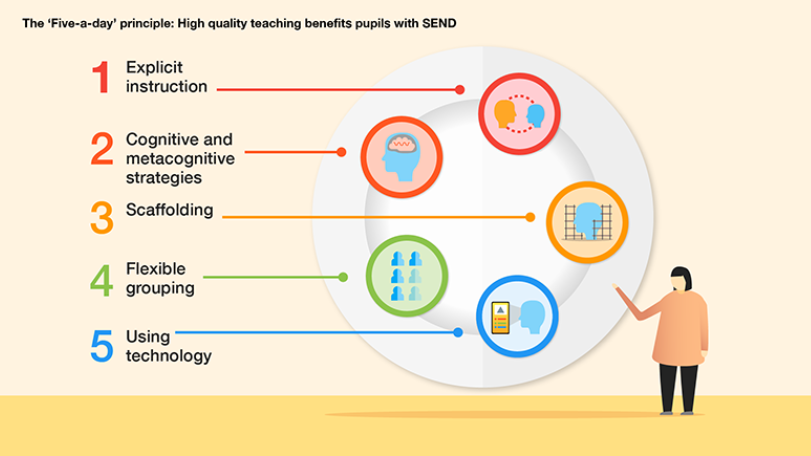
Our approach is informed by the Education Endowment Foundation's (EEF) Five-a-Day Principles for SEND, which underpin high-quality teaching for all learners:
Alongside high-quality classroom teaching, we provide a range of adaptations and reasonable adjustments to meet individual needs. These may include:
- Visual timetables, prompts and supports
- Practical and hands-on learning activities
- Adapted or simplified resources
- Dyslexia-friendly fonts and layouts
- Enlarged worksheets and oversized text
- Coloured overlays, paper or screen backgrounds
- Individual word banks, vocabulary mats or number prompts
- Specialist writing equipment or sloping writing boards
- Sensory resources and regulation strategies
- Personalised reward systems and behaviour support plans
- Targeted small-group or one-to-one support
Each class is supported by at least one teaching assistant who works alongside the class teacher to ensure that all children are fully included and supported to achieve their potential.
By combining ambitious curriculum design, adaptive teaching and personalised support, we aim to ensure that every child can access learning, experience success and thrive both academically and personally.
How will my child be included in activities outside of the classroom?
We are an inclusive school and all children have access to activities outside the classroom. This includes PE, residential trips, sporting activities, after-school and lunchtime clubs. If your child requires additional adult support or special equipment, please let us know.
We occasionally have to review this offer if children are deemed to be unsafe, but will always consider alternative arrangements so that children are able to experience a range of opportunities.
We are happy to follow any advice from outside specialist agencies.
In addition to our whole-school educational visits, we provide a range of targeted enrichment trips for small groups of pupils with Special Educational Needs and Disabilities (SEND).
These carefully planned experiences are designed to broaden children's horizons, develop confidence and independence, strengthen communication and social skills, and support important life skills outside the classroom. They also provide opportunities for pupils to experience new environments, try new activities, and build positive relationships with their peers and adults.
Our SEND enrichment programme has included visits to a variety of local and regional attractions, such as Twycross Zoo, Pizza Express, theatres, farms, and fishing experiences. These visits are tailored to meet the needs and interests of the children involved, ensuring they can access meaningful and memorable experiences that help prepare them for life beyond school.
We are proud to offer these opportunities as part of our commitment to ensuring that every child belongs, achieves and thrives.
Please click the button below to view our upcoming SEND trips for 2026–2027.
What training have staff supporting pupils with SEND had?
At Dallimore Primary and Nursery School, we are committed to ensuring that all staff have the knowledge, skills and confidence to support children with Special Educational Needs and Disabilities (SEND) effectively.
All school staff participate in an annual performance management process, during which professional development needs are identified, and appropriate training opportunities are planned. This helps ensure our staff remain up to date with current research, best practice and developments in SEND.
We regularly access training and support from a range of external agencies, including Derbyshire's Education Improvement Service, Inclusion Support Advisory Teachers (ISAT), Educational Psychology Service, Health Services and other specialist professionals. This enables us to continually develop our expertise and provide high-quality support for all children.
As a school, we have invested significantly in developing our understanding of neurodiversity. All staff, including teaching assistants, midday supervisors and office staff, have received training on neurodiversity from our SENCo, who has completed the Neurodiversity (ND) Advocate Training. This training has helped staff develop a greater understanding of neurodiverse children and the strategies that can be used to create an inclusive and supportive environment where all children feel they belong.
We have also participated in the Partnership for Inclusion of Neurodiversity in Schools (PINS) Derbyshire Project, a joint initiative between education and NHS services designed to improve understanding of neurodiversity and ensure that pupils, families, staff and the wider community feel supported and included.
Teaching Assistants receive weekly training sessions led by senior leaders to develop effective classroom practice, curriculum knowledge and strategies for supporting learning. In addition, Teaching Assistants who support children with SEND receive regular ongoing guidance, coaching and training from our SENCo and Inclusion Support Advisory Teachers (ISAT) to ensure that support remains responsive to children's needs.
Examples of SEND-related training undertaken by staff include:
- Neurodiverse Advocate Training
- PINS (Partnership for Inclusion of Neurodiversity in Schools) Derbyshire Project
- Autism Education Trust (AET) Progression Framework
- Sensory Processing and Sensory Circuits
- Year of Communication Initiative (Speech, Language and Communication Needs)
- Intensive Interaction in the Early Years
- Premature Baby Awareness Award
- Dyslexia-friendly classroom strategies
How will school support my child when they move to a new year group or key stage?
We recognise that transitions can be an exciting but sometimes challenging time for children, particularly those with SEND. We therefore plan carefully to ensure that pupils feel confident, prepared and well-supported during periods of change.
When children move between year groups, staff work closely together to ensure that all relevant information is shared with the receiving teacher. During the Summer Term, teachers meet to discuss individual pupils, including their strengths, needs, successful strategies and any support that may be required. This helps to ensure continuity of provision and a smooth start to the new academic year.
All children have the opportunity to spend time in their new classroom and meet their new teacher before the summer holidays. Where appropriate, additional transition arrangements can be made, such as extra visits, shorter transition sessions or personalised support to help children become familiar with their new environment and routines.
To support children and families further, we provide transition booklets containing key information about the new class, staff and routines. We also create transition videos featuring a welcome message from the new teacher and a tour of the classroom, which families can access over the summer holiday to help children feel reassured and prepared.
Class placements are carefully considered by teachers and senior leaders to ensure that children are placed in a learning environment where they can thrive academically, socially and emotionally.
Transition to secondary school is planned particularly carefully. We work closely with local secondary schools and share relevant information to support a successful move. Secondary school staff are invited to attend review meetings where appropriate, and additional transition visits can be arranged for pupils who may benefit from extra support. Our SENCo and SLT liaises regularly with secondary school SENCos and other key staff to ensure that each child's individual needs, strengths and support strategies are fully understood before they start their new school.
How are the school’s resources allocated and matched to pupil’s special needs?
All mainstream schools receive funding to support children with Special Educational Needs and Disabilities (SEND). This funding is used to provide a range of support, resources, interventions, staff training and reasonable adjustments to help children access learning and make progress.
At Dallimore, decisions about how resources are deployed are made by the Headteacher, SENCo and governors, based on the needs of individual pupils and the support required. As children have differing levels of need, the type and amount of support provided will vary from child to child.
As part of the graduated approach to SEND, some children may be eligible for Inclusion Funding. This is additional short-term funding provided to help schools implement targeted support, interventions or provision for children whose needs require a greater level of assistance. Inclusion Funding enables schools to assess the impact of additional support and is often used while needs are being further understood and evaluated.
Some children may have needs that require more specialist and long-term provision. In these cases, the Local Authority may carry out an Education, Health and Care Needs Assessment. If appropriate, this may lead to an Education, Health and Care Plan (EHCP).
How accessible is the school to children with SEND?
Our school is fully compliant with Disability Discrimination Act (DDA) requirements and has an up-to-date Accessibility Plan. We are committed to ensuring that all children can fully access and participate in school life.
The school site is predominantly on one level, with ramps available where there are changes in level. We also have three accessible toilets located across the school site.
We aim to ensure that all classrooms, resources, equipment and activities are accessible to every child. Educational visits, residentials and extra-curricular activities are available to all pupils, with individual risk assessments and additional support provided where necessary to enable full participation.
What is the Local Authority Local Offer?
Local Authorities are required to publish and keep under review information about the services that are available for the children and young people with Special Educational Needs aged between 0 and 25. This is the ‘Local Offer’.
The intention of the Local Offer is to improve choice and transparency for families. It is an important resource for parents in understanding the range of services and provision in the local area.

Complaints procedure
If you have any concerns or complaints regarding the welfare of your child, please do not hesitate to contact us. An appointment will be made with the Headteacher or SENCo who will be able to advise you on the correct procedures.
SEND documents